Faster Payouts
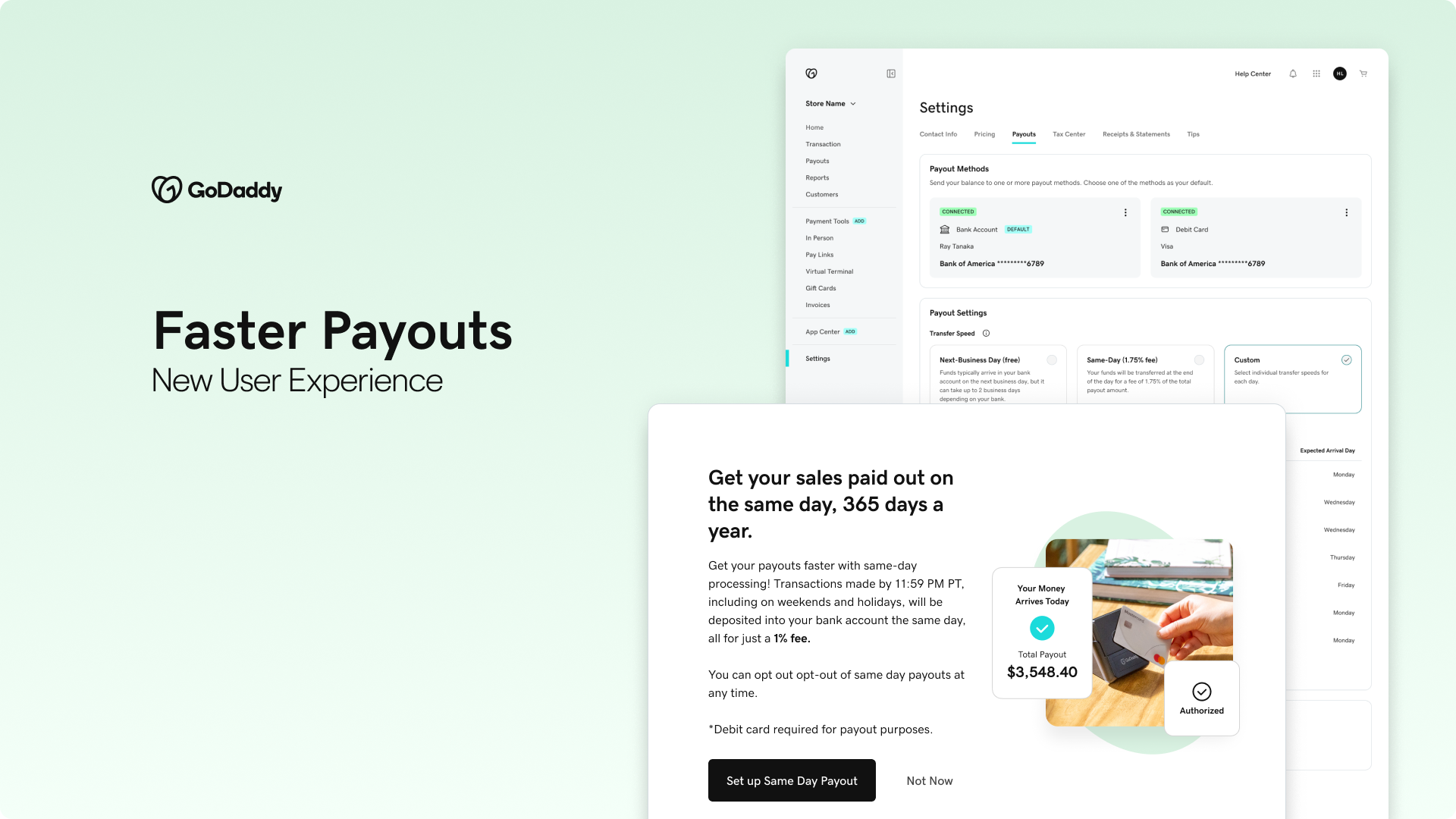
A new user experience for GoDaddy Payments merchants: self-serve same-day payouts, transparent fee disclosure, and three rollout phases that built up to a 24/7 on-demand transfer.

My Role
I led UX for the Faster Payouts initiative, focusing on:
- Crafting the end-to-end flows, including onboarding and modals that introduced the new feature.
- Running user testing and experiments to validate the solution.
- Addressing eligibility, fee transparency, and edge cases (e.g. unsupported banks).
- Collaborating with PMs, risk, compliance, and engineering across three phases of rollout.
The (user) problem
At the time, the company did not allow for flexibility regarding payout times. Merchants found it frustrating that the standard next-business-day payout is slow and has early cut-off times, limiting when they can receive their funds and manage their finances efficiently.
Meet Alissa
To ground the problem in a real shape, the team built a persona around the most affected merchant segment: small-business retailers with thin cash-flow margins.
As the owner of a retail store, I’m constantly facing challenges with cash flow because my current payment system takes up to two business days to transfer some of my sales. This delay makes it hard for me to quickly restock inventory or take advantage of spontaneous business opportunities. I really need an option that allows me to access my funds on the same day, even if it costs a bit more. Sometimes that wait, especially on the weekend, is the difference between paying bills on time or not.
The (business) problem
Beyond a drop in NPS, which ultimately contributed to rising churn rates, the company was also missing a significant opportunity to increase revenue. Although Gross Merchandise Volume (GMV) was high, there were few products in place to directly monetize that volume.
…backed up by NPS detractors and CS reports
The pattern showed up across every channel customers used to complain. Four representative quotes from NPS detractors and Customer Support tickets:
There’s not an instant transfer option available.
…I should at least be able to get my money when I want it. I am switching sites as soon as I can.
I am not able to zero out my payout summary.
Not being able to transfer money when I want to transfer it. Square and PayPal allow users to transfer money/balances at their convenience.
Research & Insights
Two complementary research tracks ran in parallel to size the opportunity and validate demand before we committed to a build:
A payouts-specific survey was launched to all active C1s who received a payout within the last year. 1,700 C1s responded (238 power-sellers, 1,462 micro-merchants).
An in-product experiment tested willingness-to-pay for both scheduled and on-demand transfer speeds across the same C1 segments — cross-checking the survey’s stated preferences against real-world behaviour.
Surveys revealed strong interest in both scheduled and on-demand instant payouts, exceeding initial projections — especially for on-demand options, which emerged as the clear user favourite across all segments. While in-product experiments showed lower-than-expected interest from power-sellers in scheduled payouts, the on-demand results aligned closely with forecasts. These findings supported moving forward with the original business case, with confidence that real-world adoption would validate the feature’s value — mirroring successful revenue trends seen in competitor platforms like Square.
Competitive Analysis
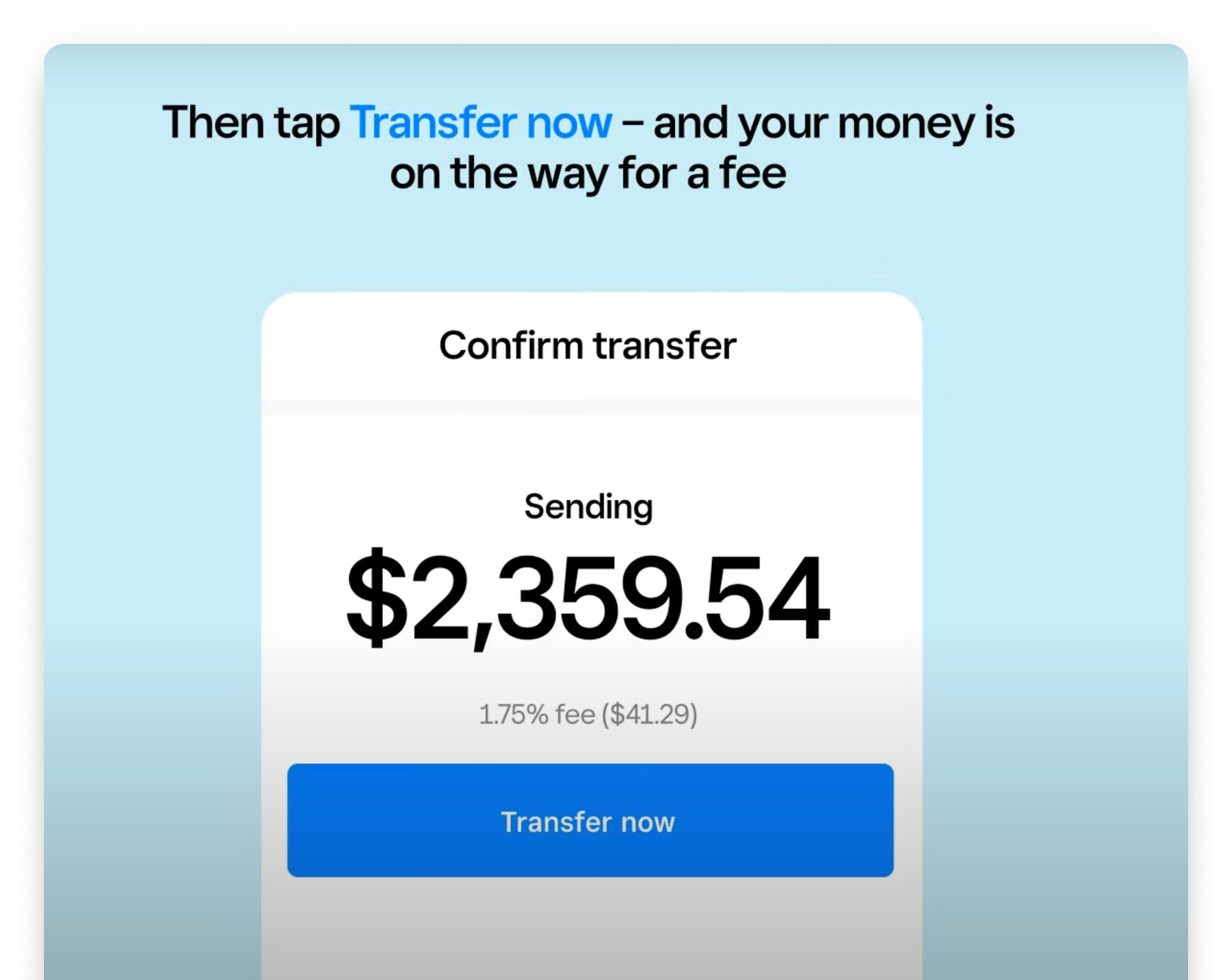
Customers have been proven to be willing to pay for the privilege of receiving their available balance faster or instantly. Square, for example, has reported ~2 years of instant payouts being their top revenue growth driver.
Hypothesis
By giving merchants the option to pay for a faster or instant payout transfer speed, we can significantly drive revenue growth and increase user satisfaction.
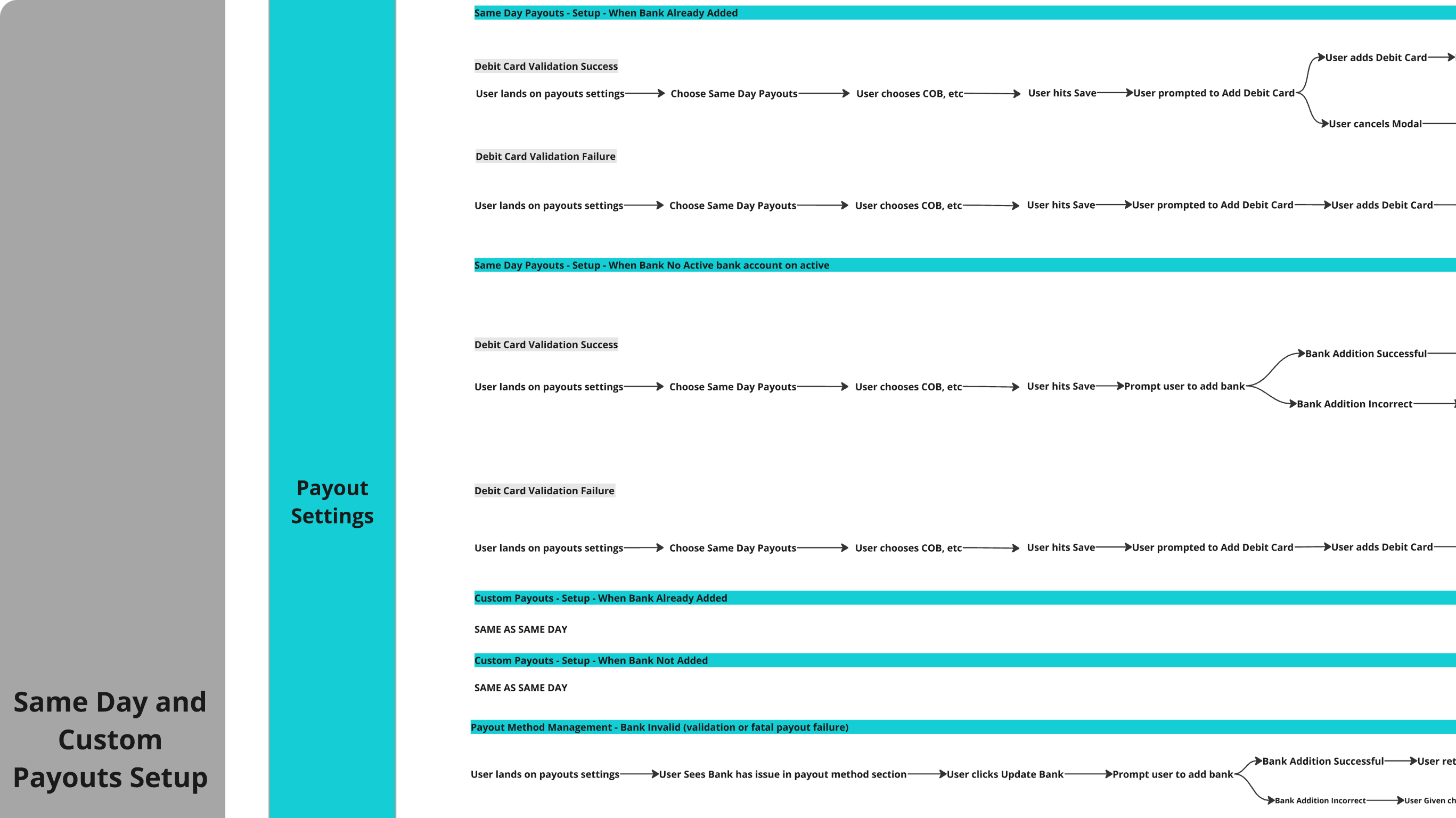
Information Architecture
Faster Payouts had to slot into an existing payments dashboard without overwhelming the merchants who didn’t need it. The IA mapped where eligibility, scheduling, and fee disclosure should live across the dashboard — and what entry points would surface them at the right moment.
The Design
The work translated into four core surfaces, each addressing a specific moment in the merchant’s journey from discovery to first successful instant payout.
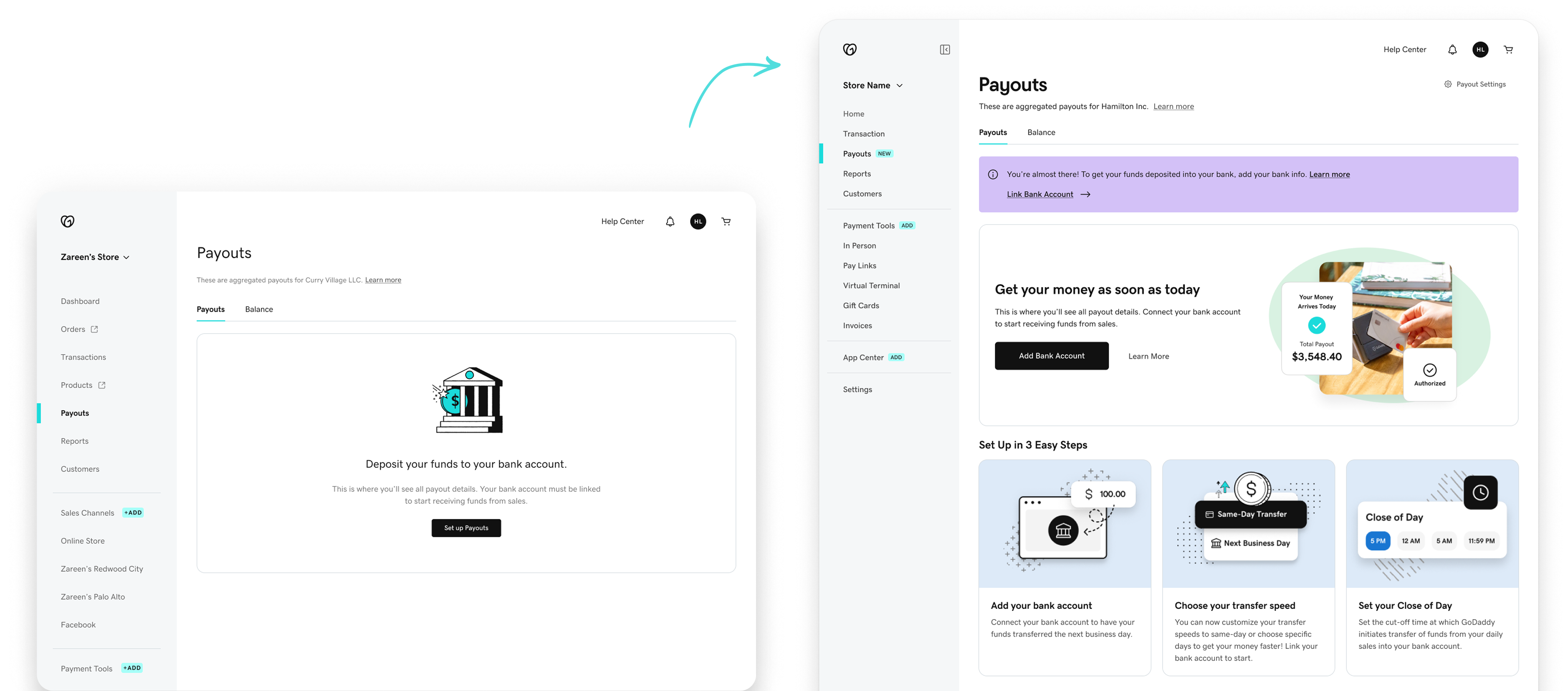
Existing vs New Payouts Page — Zero State
Before and after of the payouts landing page in its zero-state — the moment a merchant first lands on Faster Payouts without any history. The new design replaces a cold table with an action-oriented summary that surfaces eligibility and the most relevant next step.
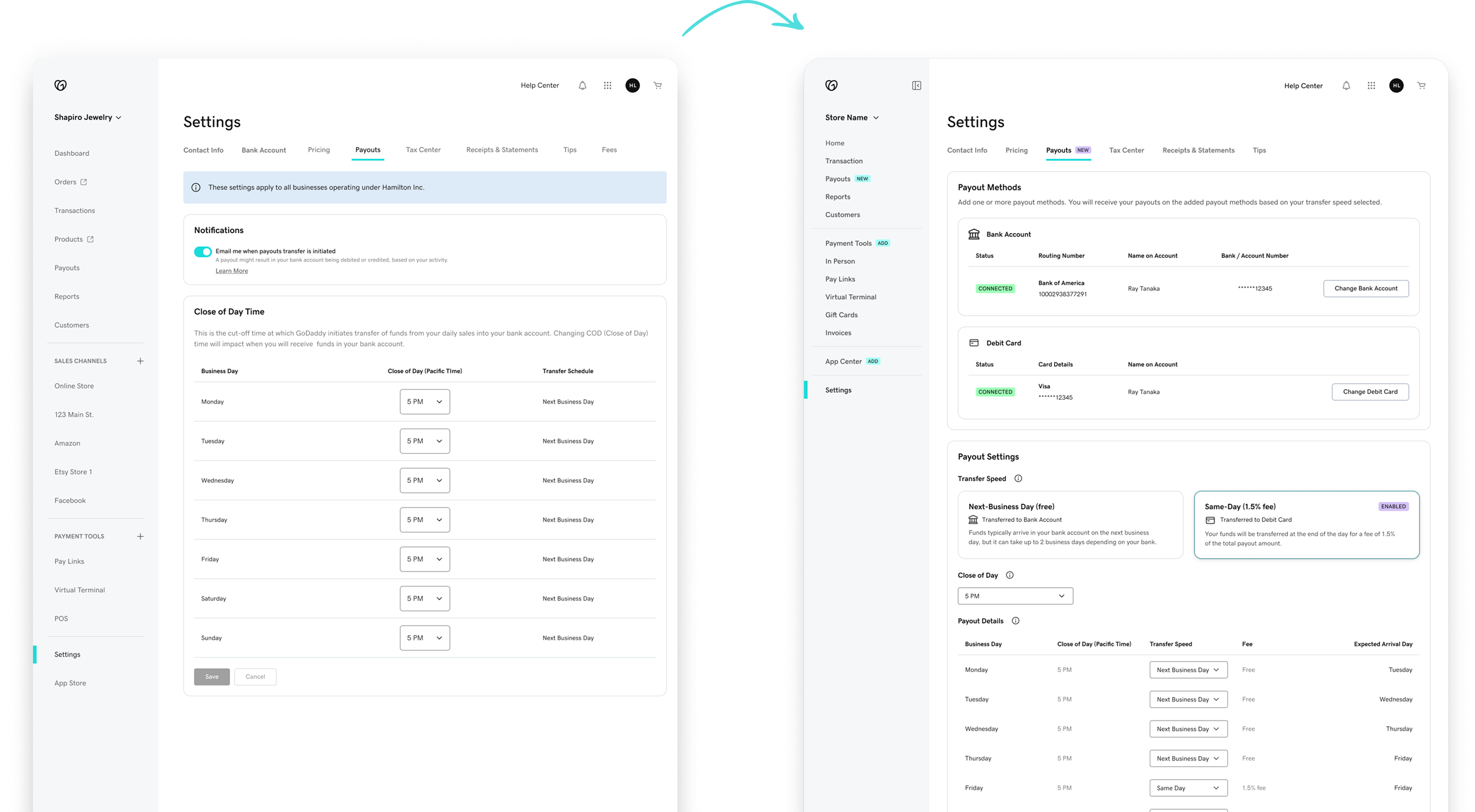
New Payout Settings Page
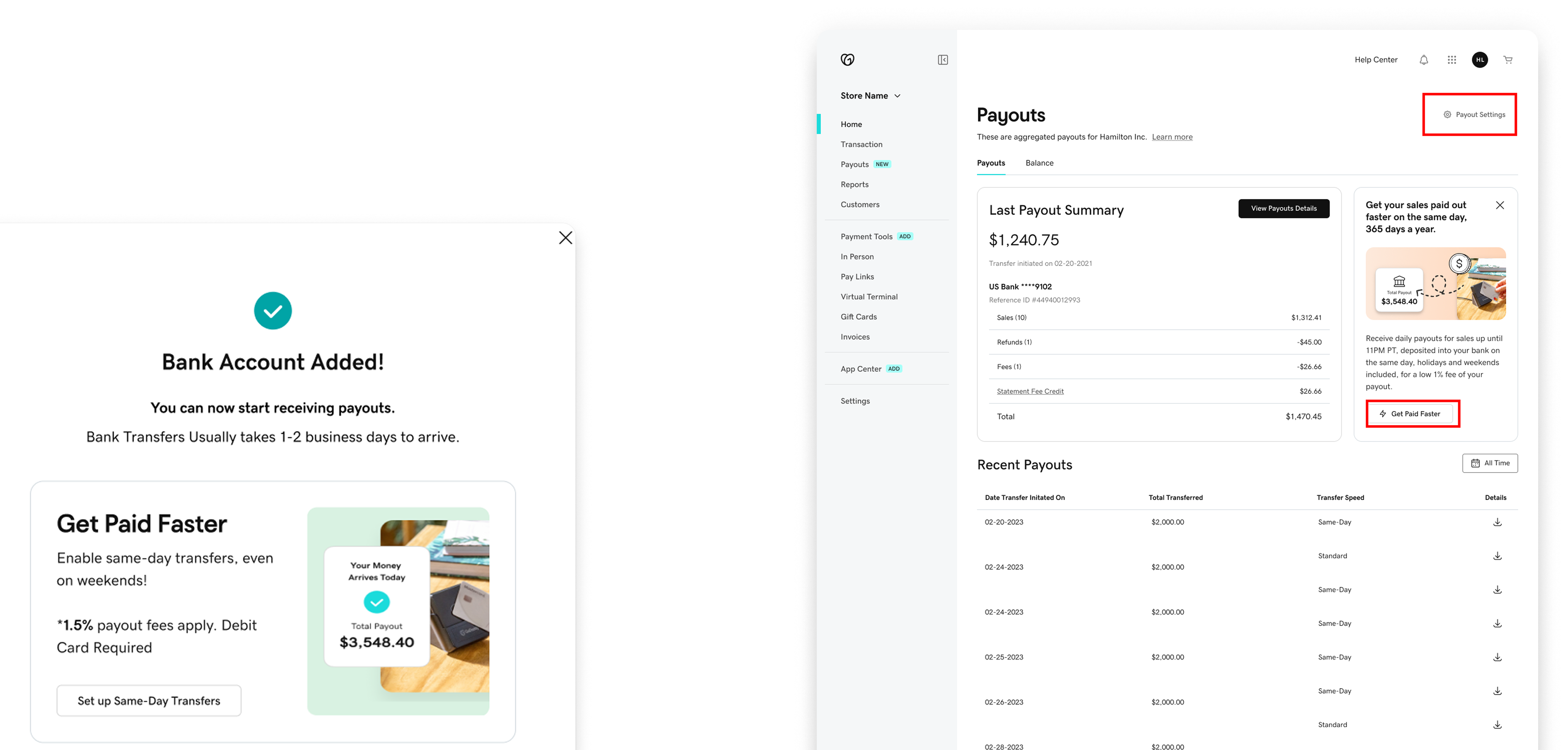
The settings surface where merchants configure their payout speed, schedule, and fee acknowledgements. Designed so the most consequential decision — opt-in to a faster payout speed — gets explicit confirmation rather than burying it behind a default toggle.
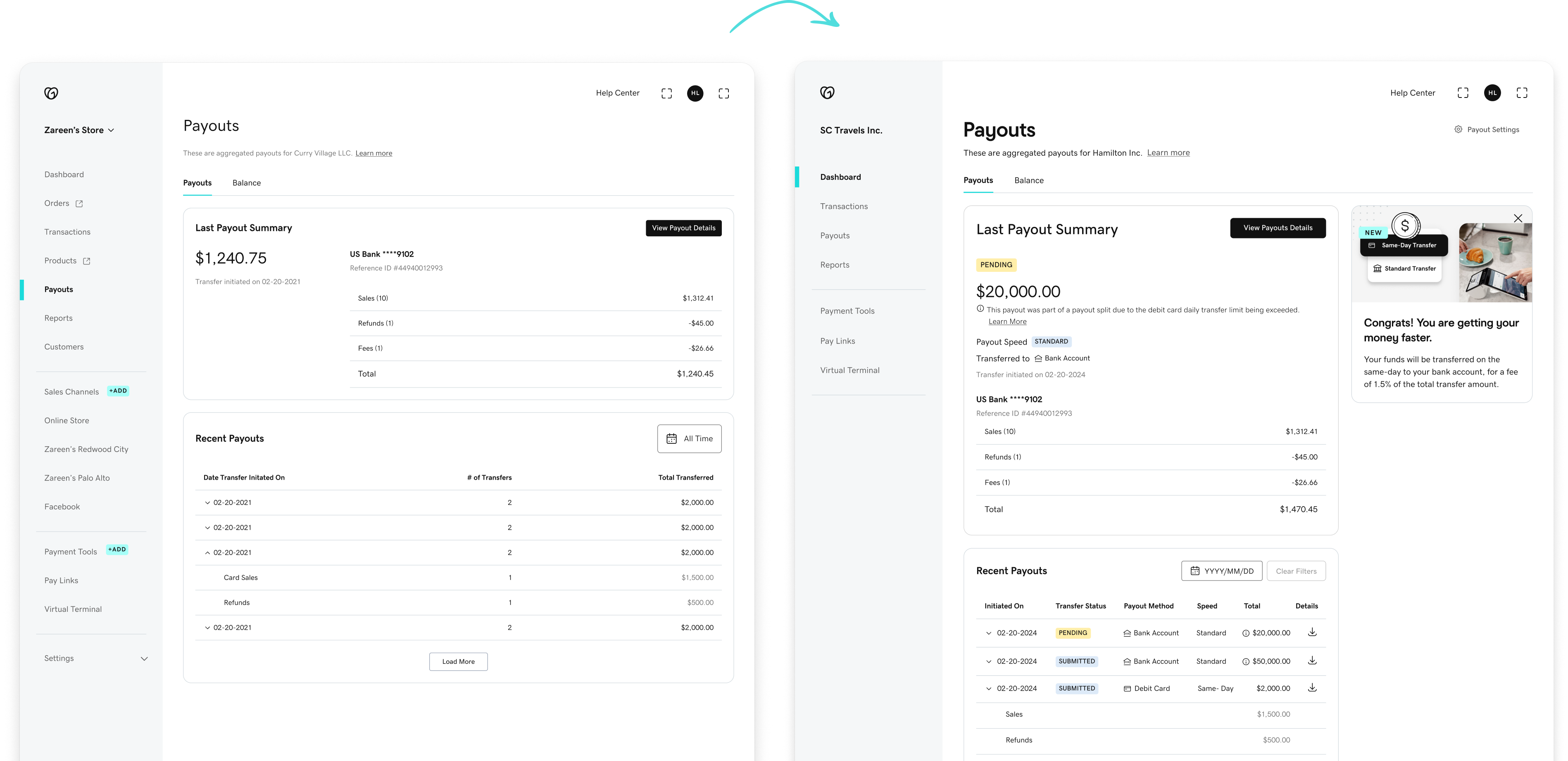
New Payouts Page
The everyday view: today’s summary card, recent payouts table, and a contextual Faster Payouts callout that nudges eligible merchants without disrupting the flow for those who aren’t targeted.
New Entry Points
Faster Payouts had to be discoverable from outside the payouts page itself. Three entry points were designed across the dashboard so eligible merchants always had a clear, contextual path to opt in.
Validation & User Testing
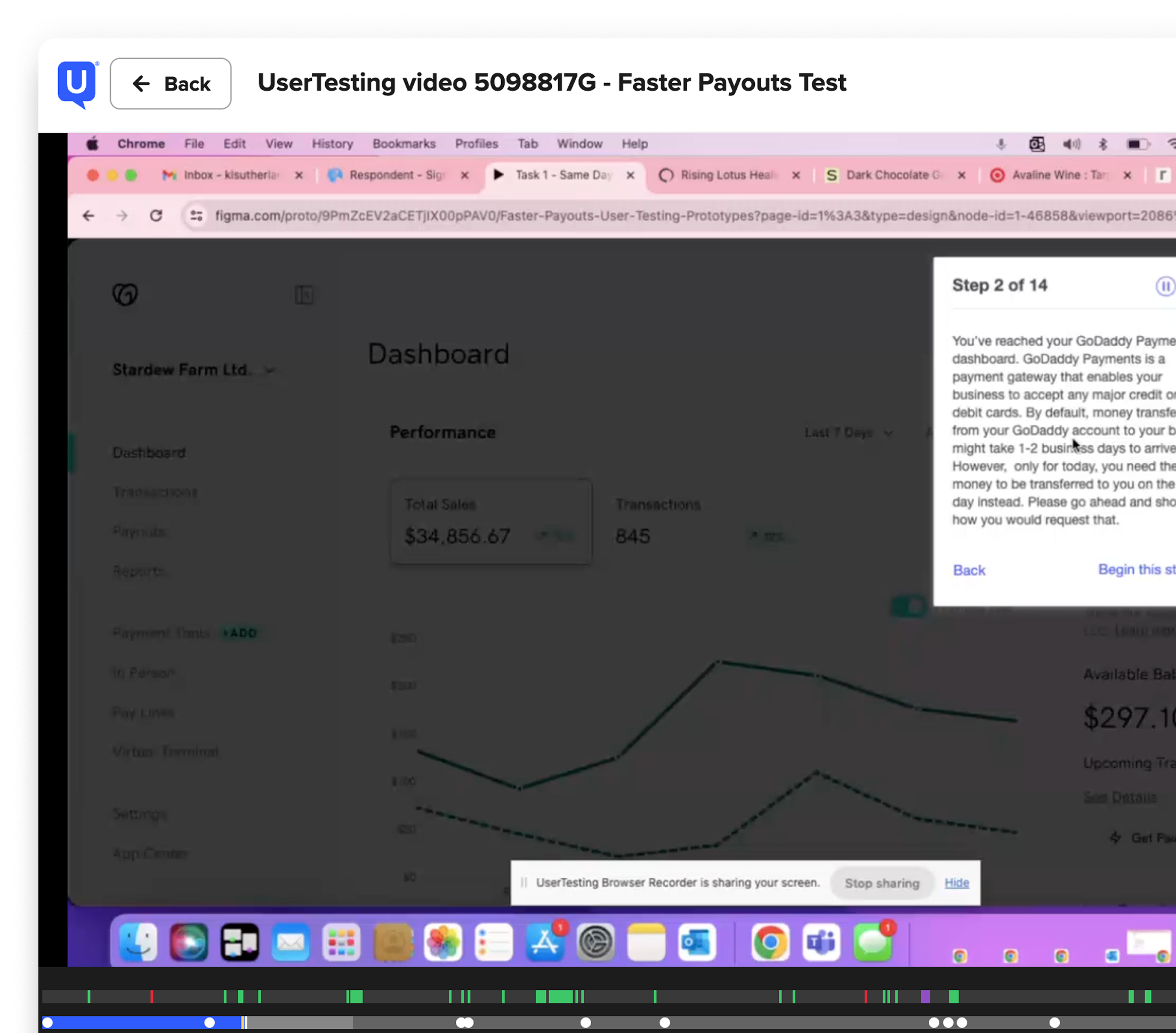
Design decisions were tested out during unmoderated usability testing with groups of 7–11 users, with overall positive feedback. This approach not only allowed us to test the efficiency of the designs, but also to find improvement opportunities and try different scenarios and capabilities, such as:
- Managing same-day payouts
- Custom-scheduled payouts
- Faster Payouts entry points
Impact
The feature launched successfully ahead of schedule and outperformed all KPIs. Merchants can now request payouts 24/7 — even on weekends — direct to bank or debit card, with funds arriving within minutes. Faster Payouts became a competitive differentiator and a new recurring revenue stream for the business.